

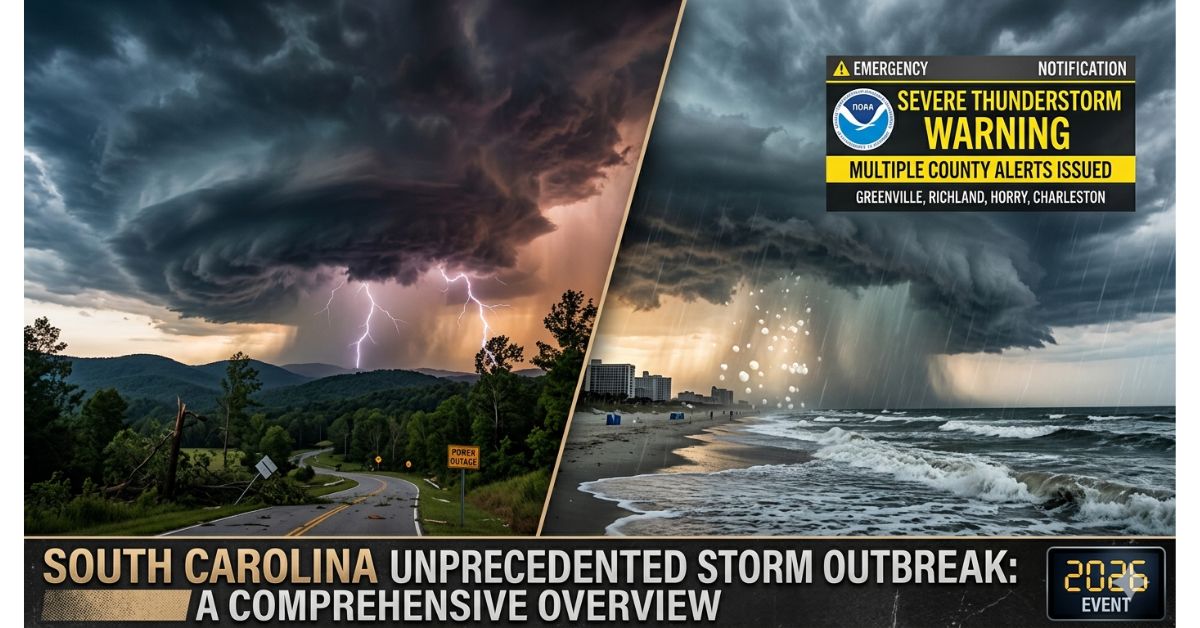
South Carolina has long lived at the intersection of dramatic weather. The Palmetto State’s unique geography — stretching from the Blue Ridge foothills in the northwest to the Atlantic coastline in the southeast — makes it one of the Southeast’s most weather-volatile states. When the National Weather Service issues multiple severe thunderstorm alerts across its counties simultaneously, it is not a routine announcement. It is a call to action.
In early 2026, that call came loudly and repeatedly. A powerful storm system tracked across the region, triggering a cascade of warnings that touched nearly every corner of the state — from the Upstate counties of York, Chester, and Spartanburg to the coastal communities of Beaufort, Colleton, and Jasper. What unfolded was a multi-day weather event that tested the preparedness of local emergency managers, residents, and first responders alike.
This article takes a deep, detailed look at those alerts — what triggered them, which areas were affected, what dangers were involved, and what South Carolinians should know to stay safe the next time such a system bears down on the state.
Understanding the Alert System: Watch vs. Warning
Before diving into the specifics of the storm event itself, it helps to understand the alert language the National Weather Service uses — because the difference between a watch and a warning carries real, life-or-death significance.
Severe Thunderstorm Watch: Issued when atmospheric conditions are favorable for severe storm development. The watch area is typically broad, often covering multiple counties or even entire states. Residents in a watch zone should begin preparations, monitor updates, and be ready to act — but storms have not yet formed or confirmed.
Severe Thunderstorm Warning: Issued when a severe storm has either been confirmed by trained weather spotters on the ground or detected by radar. This is an imminent threat. Warnings require immediate action — seek shelter in a sturdy building, stay away from windows, and avoid travel.
Tornado Warning: During severe thunderstorm events, rotating storms can quickly escalate into tornado warnings. If your county receives a tornado warning while under a thunderstorm warning, treat it with the utmost seriousness.
The NWS also uses a tiered system of Significant Severe Thunderstorm Warnings — color-coded “Particularly Dangerous Situation” (PDS) alerts — when storms are producing extremely large hail or exceptionally destructive winds. These are rare, and their issuance signals storms at the upper end of the severity scale.
During the early 2026 events across South Carolina, warnings were issued in rapid succession, with some counties seeing multiple active alerts overlapping over just a few hours.
What Triggered the Storms: The Atmospheric Setup
Severe thunderstorms do not appear from nowhere. They are the product of specific atmospheric conditions colliding in just the right way. The 2026 South Carolina storm events were no exception.
Meteorologists identified the following key drivers behind the outbreak:
1. Warm, Moist Air from the Gulf and Atlantic
A surge of warm, humid air flowing in from both the Gulf of Mexico and the Atlantic Ocean provided the primary fuel for storm development. South Carolina’s coastal geography makes it particularly susceptible to this type of moisture loading, especially during late winter and early spring when temperature contrasts are at their sharpest.
2. A Fast-Moving Upper-Level Disturbance
A strong upper-level trough — a dip in the jet stream — was tracking in from the west, providing the atmospheric lift needed to destabilize the air column. When warm, moist surface air meets this kind of upper-level forcing, it rises rapidly, cools, condenses, and forms towering cumulonimbus clouds capable of producing violent weather.
3. Wind Shear
Changes in wind speed and direction at different altitudes — known as wind shear — provided rotation potential. Wind shear is the ingredient that separates ordinary thunderstorms from severe, long-lived, and sometimes tornadic ones. During the South Carolina event, forecasters identified notable shear profiles across the Upstate, increasing tornado concerns.
4. Temperature Gradients
Sharp temperature contrasts between the warmer air to the south and cooler air pushing in from the northwest helped trigger rapid storm initiation along the frontal boundary. These boundaries act as focal points for thunderstorm development, and South Carolina’s geography often channels them directly across the most populated corridors.
The result: an environment meteorologists describe as “primed” — one where storms could fire explosively, intensify rapidly, and sustain severe conditions for an extended period.
A State on Alert: The Affected Counties
The geographic scope of the storm system was striking. Alerts were not confined to a single region of South Carolina — they blanketed much of the state from west to east as the storm system tracked northeast.
Upstate South Carolina
Counties including York, Chester, Spartanburg, Greenville, and Anderson were among the first to come under active warnings. These areas experienced some of the most intense storm activity, with wind gusts clocking in at or near 60 mph. Structural damage to outbuildings, downed trees, and power outages were reported across parts of the Upstate. The NWS office in Greenville-Spartanburg issued multiple short-fused warnings throughout the afternoon and evening, tracking storm cells in real time.
The I-85 and I-26 corridors — major arteries connecting the Upstate to the Midlands — were particularly hazardous during the event, with low visibility, standing water, and debris on roadways creating dangerous driving conditions.
The Midlands
As storms moved northeast, counties in the Midlands corridor — including Richland and Lexington, which encompass the greater Columbia metropolitan area — came under severe thunderstorm watches and warnings. Columbia residents were advised to secure outdoor items and shelter in place. The urban density of the Columbia area meant even moderate wind events had the potential to affect large numbers of people.
The Lowcountry and Coast
The storm system’s track eventually brought it to the Lowcountry and coast, where counties such as Beaufort, Colleton, Jasper, Charleston, Berkeley, and Dorchester received warnings. Coastal topography presents unique challenges during storm events — tidal flooding can compound rain-driven flooding, and manufactured homes or structures built on stilts can be especially vulnerable to high winds.
The Grand Strand
Horry and Georgetown counties, home to Myrtle Beach and the popular Grand Strand tourist corridor, also came under warnings, with the NWS reporting threats of hail up to 2 inches in diameter and wind gusts of 60 mph near Myrtle Beach International Airport and surrounding communities including Surfside Beach, Garden City, and Murrells Inlet.
For a coastal tourism economy, the timing of severe weather events — and the speed with which warnings are issued and communicated — has direct implications not just for safety, but for the livelihoods of the region’s residents and businesses.
Primary Hazards: What the Storms Brought
Severe thunderstorm warnings cover a range of potential hazards, and the South Carolina event involved most of them.
Damaging Winds
Wind gusts exceeding 60 mph were the most widespread hazard. At those speeds, winds can:
- Snap or uproot mature trees
- Tear shingles from roofs
- Collapse fences and weak outbuildings
- Send unsecured outdoor furniture and debris airborne
- Bring down power lines, causing outages and electrocution hazards
Utility crews were placed on standby across several counties ahead of the storms’ arrival, anticipating widespread outages.
Heavy Rainfall and Flash Flooding
Intense rainfall rates accompanied by slow storm motion in some areas created flash flooding conditions in low-lying areas, underpasses, and flood-prone roadways. Forecasters specifically warned drivers against attempting to cross flooded roads — a hazard responsible for more storm-related fatalities in South Carolina each year than any other weather threat.
Large Hail
Hail was confirmed with some of the stronger cells, particularly along the coast near Horry and Georgetown counties, where the NWS reported hail up to 2 inches in diameter — roughly the size of a golf ball. At that size, hail poses real risk of injury to anyone caught outdoors and can cause significant damage to vehicles, roofing, and crops.
Lightning
Every severe thunderstorm is, by definition, a massive electrical event. Lightning strikes during the storm event posed serious risk to anyone outdoors, particularly in open areas, on bodies of water, or near tall trees. South Carolina consistently ranks among the states with the highest lightning-related injuries and fatalities, making this hazard one that demands consistent respect.
Tornado Potential
Perhaps the most feared threat during the event was the elevated tornado risk. While not every severe thunderstorm produces a tornado, the atmospheric conditions present during this system — particularly the wind shear profiles across the Upstate — increased the probability of rotating storms. Forecasters urged residents in affected counties to have multiple ways to receive tornado warnings and to identify shelter locations in advance.
Community Impact: Power, Roads, and Emergency Response
The cascading effects of a multi-county storm outbreak stretch well beyond the physical damage caused by wind and rain.
Power Outages: Tens of thousands of customers across South Carolina experienced power disruptions during the event. Utility crews from Duke Energy, Dominion Energy South Carolina, and several electric cooperatives mobilized to assess and restore service. In some rural areas, restoration took multiple days, leaving residents without heating, refrigeration, and communication.
Road Closures: Emergency managers and the South Carolina Department of Transportation coordinated to close several roadways impacted by flooding, downed trees, and debris. Residents were urged to follow detour signage and avoid unnecessary travel until conditions stabilized.
Emergency Services: Fire departments, rescue squads, and law enforcement across affected counties responded to surge volumes of calls — from accident scenes to downed-wire calls to welfare checks on elderly residents. Pre-positioned emergency response assets helped reduce response times in the most severely impacted areas.
Schools and Public Facilities: Several school districts in the path of the storms implemented early dismissals or shelter-in-place procedures to keep students safe. Athletic events, outdoor gatherings, and community programs were canceled across multiple counties.
The Warning Timeline: How Alerts Move Across the State
One of the most important aspects of this storm event — from a public safety perspective — was how quickly and efficiently the warning system communicated risk as the storm moved east.
The NWS offices responsible for South Carolina coverage — primarily Greenville-Spartanburg (GSP), Columbia (CAE), and Charleston (CHS) — coordinate their warnings in real time, using a combination of Doppler radar analysis, trained ground-based SKYWARN spotters, and automated weather stations.
As storms first developed over the Upstate in the afternoon hours, initial warnings were issued with roughly 10–20 minutes of lead time — enough for most residents paying attention to reach shelter. As the line moved northeast, downstream counties received earlier notification due to the established storm track, allowing more preparation time for communities in the Midlands and coastal zones.
Emergency managers pushed notifications through multiple channels:
- Wireless Emergency Alerts (WEA) — the loud, intrusive alerts sent directly to cell phones in warned counties
- NOAA Weather Radio — the continuous broadcast service that reaches homes, schools, and businesses with battery-backup capability
- Local television broadcasts — meteorologists across the state went wall-to-wall during the most active periods
- Social media and county emergency management pages — real-time updates kept digitally connected residents informed
What You Should Do: A Safety Guide for South Carolina Residents
Living in South Carolina means living with severe weather as a seasonal reality. Here is what every resident — from the Upstate to the coast — should know and do when multiple thunderstorm alerts are issued.
Before the Storm
- Monitor forecasts daily during active weather seasons (spring and late summer/early fall are peak periods). Use the NWS app, Weather.gov, or a trusted local meteorologist.
- Build an emergency kit that includes flashlights, batteries, a battery-powered or hand-crank weather radio, bottled water, non-perishable food, a first aid kit, and important documents in waterproof storage.
- Trim trees and secure outdoor items. Loose furniture, decorations, and debris become dangerous projectiles in high winds.
- Identify your shelter location — an interior room on the lowest floor of a sturdy building, away from windows.
- Charge devices when severe weather is forecast, so you have communication capability during and after an event.
During the Storm
- Get indoors immediately. Do not wait to see the storm develop — by the time you can see a tornado or feel dangerous wind gusts, it is too late to safely evacuate.
- Stay away from windows. Even in a “regular” severe thunderstorm, windows can shatter from hail or wind-driven debris.
- Do not shelter under trees or in open structures. These offer no protection from lightning or wind.
- Never drive through flooded roads. Just six inches of fast-moving water can knock a person down; 12 inches can carry away a small vehicle.
- Unplug sensitive electronics if time allows, to protect against power surges from nearby lightning strikes.
After the Storm
- Watch for downed power lines. Treat every downed wire as live and dangerous.
- Be cautious entering damaged structures. Check for gas leaks, structural instability, and standing water before entering.
- Document damage with photographs for insurance purposes before cleaning up.
- Check on neighbors, particularly elderly or disabled individuals who may need assistance.
- Report storm damage to your local emergency management office or NWS — ground truth helps forecasters improve future warnings.
South Carolina’s Climate Reality: Why This Keeps Happening
South Carolina’s severe weather vulnerability is not accidental — it is baked into the state’s geography and climate. The state occupies a zone where several major weather patterns converge:
- Warm, moist Atlantic and Gulf air streams in regularly from the south, fueling convective instability.
- Cold fronts diving south from Canada clash with that warm air in an area centered squarely on the Southeast United States.
- The Appalachian foothills channel and enhance storm development in the Upstate, creating localized zones of elevated tornado and wind risk.
- The coast faces the additional complications of sea-breeze boundaries, tidal flooding compounding storm surge, and higher populations in vulnerable areas like manufactured housing communities.
Climate scientists have also noted that the intensity and frequency of severe thunderstorm outbreaks in the Southeast have shifted over recent decades, with storm seasons beginning earlier in the calendar year and producing more events outside of the traditional spring peak. This is a trend South Carolina residents and emergency planners must continue to take seriously.
The Role of Technology: Better Warnings, Safer Outcomes
One dimension of the 2026 events that deserves recognition is the role that modern meteorological technology played in protecting lives. The National Weather Service’s dual-polarization Doppler radar network — capable of distinguishing hail from rain, identifying debris signatures from tornadoes, and providing higher-resolution storm structure data — enabled forecasters to issue more precise, timely, and targeted warnings than was possible even a decade ago.
Wireless Emergency Alerts sent directly to cell phones have also dramatically improved the reach of storm warnings, particularly for residents who are not actively monitoring television or radio. The near-universal penetration of smartphones in South Carolina’s population means that a warning issued in any county has a high probability of reaching nearly every resident within seconds.
Still, technology is only as effective as the people who act on it. The most sophisticated warning system in the world cannot protect someone who ignores the alert or waits too long to seek shelter.
Conclusion: Respect the Storm, Protect Your Community
The multiple severe thunderstorm alerts issued across South Carolina counties in early 2026 were a reminder — not that South Carolina’s weather is exceptional in its danger, but that it is consistently, reliably capable of turning lethal with very little warning. The communities that fared best were those where residents took the alerts seriously, sheltered quickly, and supported their neighbors before, during, and after the storms passed.
Every storm season brings another opportunity to prepare, to update emergency plans, and to reinforce the message that no outdoor activity, commute, or errand is worth risking life during an active severe thunderstorm warning.
South Carolina is a beautiful state. It is also a storm-prone one. The two facts coexist — and the residents who thrive here are those who have learned to respect both.
For the latest weather alerts and warnings, visit weather.gov or download the NWS app. In a life-threatening emergency, call 911.