
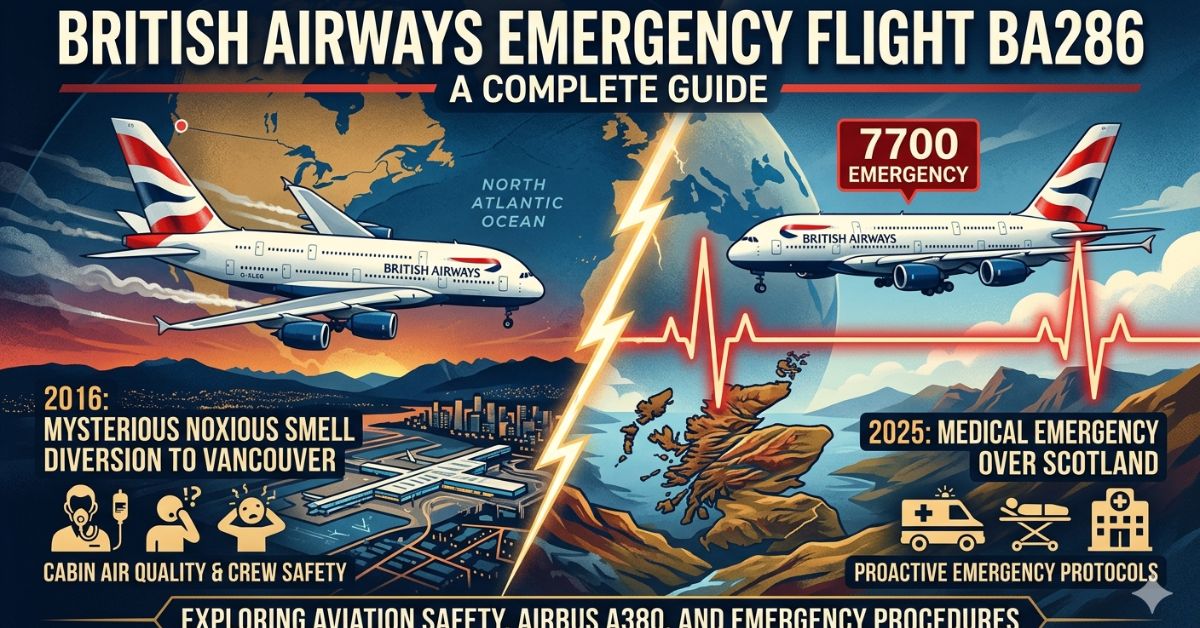
When a transatlantic flight diverts mid-ocean or a wide-body jet squawks an emergency code over Scotland, people take notice. The search term “British Airways emergency flight BA286” has drawn significant online interest — and for good reason. The BA286 flight number has been connected to two separate, widely covered emergency events spanning nearly a decade. Together, they offer a compelling window into how modern aviation handles crises, how flight crews are trained to react under pressure, and what passengers can expect when things go wrong at 41,000 feet.
This article covers both notable BA286 incidents in full — the 2016 emergency diversion to Vancouver and the 2025 medical emergency over Scotland — alongside broader context about aviation safety, the Airbus A380, and the protocols that protect passengers every time they fly.
Understanding the BA286 Route
British Airways flight BA286 operates one of the most iconic transatlantic corridors in commercial aviation: San Francisco International Airport (SFO) to London Heathrow (LHR). The journey spans roughly 5,360 miles and takes approximately ten hours westbound and slightly less eastbound, crossing the North American continent, the Arctic, and the North Atlantic Ocean before descending into Heathrow.
For this long-haul route, British Airways typically deploys its Airbus A380 — the world’s largest commercial passenger aircraft — capable of carrying between 469 and 850 passengers depending on cabin configuration. BA’s version seats around 469 across four classes. The sheer size of the aircraft adds a layer of complexity to any emergency response, since diverting and landing an A380 requires runways of sufficient length and airports equipped to handle its unique ground support needs.
Incident 1: The 2016 Vancouver Emergency Diversion
What Happened
On the night of October 24, 2016, British Airways flight BA286 departed San Francisco bound for London Heathrow carrying approximately 388 passengers and 25 crew members. The aircraft — an Airbus A380 — climbed to cruise altitude and the flight proceeded normally through the first couple of hours. Dinner service had just been completed when everything changed.
About 40 minutes after takeoff, crew members near the main cabin door and the upper deck galley area began detecting a powerful, acrid smell variously described as burning plastic or toxic fumes. What followed unfolded quickly. Cabin crew members started showing alarming symptoms: dizziness, nausea, headaches, confusion, itchy and red eyes, a metallic taste in the mouth, and in some cases an inability to think clearly or communicate normally. The situation was serious enough that the captain declared an emergency, notifying air traffic control that the problem involved what he described as “toxic gas-type fumes.”
The flight crew, with their ability to act decisively under pressure, initiated a diversion. The aircraft was initially planned to land in Calgary, but because the A380’s enormous size requires specific runway and infrastructure capabilities, the destination was changed to Vancouver International Airport — a larger facility better equipped to handle the situation. The aircraft conducted fuel-dumping procedures during the descent to reduce landing weight, a standard protocol for wide-body jets executing unplanned landings that would otherwise see the aircraft come in too heavy for safe contact.
Flight BA286 touched down at Vancouver International Airport at around 11:30 p.m. Pacific Time and was immediately met by emergency vehicles. All 25 crew members — flight attendants and the three pilots — were transported to hospitals across the Vancouver region. Remarkably, all were treated and subsequently discharged. Passengers disembarked without serious physical injuries, though many were understandably shaken and frustrated, left to sort out alternative flights and accommodations overnight.
The Mysterious Cause
What made the 2016 BA286 incident particularly notable was not just the emergency itself, but the fact that investigators were never able to definitively determine its cause. Transport Canada classified the triggering factor as a “strong noxious smell” on the upper flight deck, but what produced that smell remained elusive. British Airways and Airbus both conducted exhaustive technical inspections of the aircraft’s systems. Bill Yearwood of Canada’s Transportation Safety Board confirmed that all available investigative techniques had been applied but yielded no clear answers. With no definitive cause found, the aircraft was returned to service and the file was officially closed.
A leaked internal report written by the flight’s cabin service director later revealed the full extent of the crew’s experience. Attendants were described as “spaced out,” wandering around the cabin appearing lost. Some were observed sitting in corners on the floor with blankets over their heads. One remarkable detail described crew members “stuffing food into their mouths while wearing oxygen masks” — a sign of the disorientation and impaired judgment that had overtaken them. Symptoms reportedly persisted in some crew members after leaving hospital, with at least one collapsing and vomiting after returning to the UK days later.
Industry Response and the Fume Event Debate
The 2016 BA286 incident reignited a long-running debate within the aviation industry about “fume events” — occasions when contaminated or unusual air enters the cabin environment, potentially affecting those on board. The Unite trade union, which represents British Airways cabin crew, argued that the incident was a clear example of airlines and manufacturers downplaying the genuine health risks posed by cabin air quality issues. The union called for a broader industry-wide review.
British Airways, for its part, described the event as an “odour event” — a characterization that Unite found dismissive given the severity of the crew’s symptoms. The airline maintained that no fault had been identified with the aircraft. The gap between the lived experience of the crew and the official findings highlighted a persistent tension in aviation: the difficulty of proving a causal link when all physical evidence has dissipated by the time investigators arrive.
Incident 2: The 2025 Medical Emergency Over Scotland
What Happened
Nearly nine years later, the BA286 flight number made headlines again under very different circumstances. On May 27, 2025, British Airways flight BA286 — again the San Francisco to London Heathrow service — departed SFO at 19:33 Pacific Daylight Time on May 26, 2025, with an Airbus A380 bearing the registration G-XLEG. The flight crossed the North American continent and the Atlantic through the night and into the following morning without incident.
However, as the aircraft entered UK airspace and passed over Scotland while cruising at 41,000 feet, the flight crew transmitted a squawk 7700 — the universal transponder code for a general emergency — and declared a medical emergency on board. The pilots requested priority handling and expedited clearance for landing at London Heathrow Airport.
Unlike the 2016 diversion, the 2025 emergency did not require a change of destination. The aircraft was already close to its intended endpoint, and Heathrow’s air traffic control prioritized the flight accordingly. BA286 landed on Runway 27L at approximately 13:39 British Summer Time. Shortly afterward, the aircraft was guided to stand C56, where medical personnel were on hand to assist.
Nature of the Emergency
The 2025 incident was classified as a medical emergency — meaning a passenger or crew member had experienced a serious health event requiring urgent ground-based medical intervention. Aviation authorities and airlines routinely manage on-board medical situations, and pilots are trained to declare emergencies when the condition of a person on board is serious enough that delayed landing could have life-threatening consequences. In such cases, declaring an emergency ensures that medical teams, emergency vehicles, and airport resources are staged and ready before the aircraft even touches down — potentially saving critical minutes.
Details about the specific nature of the medical situation were not publicly released, which is standard practice to protect the privacy of the individual involved.
The Airbus A380: Safety by Design
Both BA286 emergencies involved the Airbus A380, which deserves some context. The A380 entered commercial service in 2007 and quickly became one of the most scrutinized aircraft in aviation history — both because of its unprecedented scale and because it represented a bold technological leap. The double-deck, four-engine wide-body jet is designed with layers of redundancy across every critical system.
Each engine operates independently, meaning the failure of one — or even two — does not compromise the aircraft’s ability to fly and land safely. The cabin pressurization system, hydraulics, and electrical systems all feature multiple backup circuits. The A380’s fly-by-wire controls reduce the chance of human error by filtering out inputs that could exceed the aircraft’s structural tolerances.
As of May 2025, British Airways operated a fleet of 12 A380s, with 10 actively deployed across high-demand routes including San Francisco, Los Angeles, Miami, Boston, Johannesburg, and Washington Dulles. The aircraft is widely regarded as one of the safest long-haul platforms in commercial aviation.
What Does “Squawking 7700” Actually Mean?
When a pilot activates squawk code 7700 on their transponder, they are broadcasting a signal to all air traffic control facilities in range that the aircraft is experiencing a general emergency. This code triggers an immediate, coordinated response across multiple agencies:
Air traffic controllers will clear surrounding airspace, giving the aircraft priority over all other traffic. Controllers will offer the shortest routing to the nearest suitable airport. Emergency services at the destination airport are placed on standby. The airline’s operations center is notified and begins coordinating ground support.
It is worth noting that squawking 7700 does not necessarily mean the aircraft is in imminent danger of crashing. It is a precautionary tool, and pilots are encouraged to use it whenever a situation has the potential to escalate. In both of BA286’s most notable emergencies, the aircraft landed safely and without structural incident. The code is a signal to the system to mobilize — it is the aviation equivalent of calling emergency services before you are certain you need them, because the cost of calling and not needing help is always lower than needing help and not having called.
Emergency Procedures: What Airlines Practice Constantly
Both of the BA286 emergencies, while distressing for those on board, demonstrated the aviation industry’s emergency response framework working largely as intended. The 2016 crew recognized a developing crisis, communicated it to air traffic control, executed a diversion to a suitable airport, and ensured all passengers and crew were safely evacuated and medically assessed. The 2025 crew declared a medical emergency in time to have ground support ready upon arrival, avoiding any delay in care for the individual concerned.
Flight crews undergo recurrent emergency training multiple times per year. This training covers scenarios ranging from engine failures and cabin decompression to fire suppression, medical response, and controlled diversions. Cabin crew, meanwhile, are trained as first responders — qualified in CPR, defibrillator use, oxygen administration, and emergency evacuation management.
Airlines also run dedicated operations control centers that monitor every flight in real time. When a squawk 7700 is detected or a diversion is initiated, the operations center coordinates with destination airports, local emergency services, incoming passenger care teams, and the aircraft simultaneously.
Passenger Rights After an Emergency Diversion
One question that naturally arises after incidents like the 2016 BA286 diversion is: what are passengers entitled to?
Under UK261 (formerly EU261 before Brexit), passengers on flights departing from or arriving at UK airports are entitled to compensation for long delays and cancellations — but only when the disruption is within the airline’s control. Medical emergencies and safety-related diversions are generally classified as “extraordinary circumstances,” which can exempt airlines from paying standardized cash compensation.
However, airlines typically remain responsible for providing passengers with meals, refreshments, accommodation, and rebooking on the next available service. Passengers in the 2016 diversion reported frustration with the pace of communication and some confusion over expense reimbursement — a reminder that even when an airline handles the safety dimension well, the pastoral care dimension often leaves room for improvement.
Broader Lessons from BA286
The twin emergencies associated with flight BA286 carry several important lessons that extend beyond any single incident:
On crew health and fume events: The 2016 incident highlighted that the health of cabin crew is not a secondary concern — it is a fundamental operational safety issue. Crew incapacitation can compromise the airline’s ability to manage an evacuation or respond to secondary emergencies. The unresolved cause of the 2016 Vancouver diversion has continued to fuel calls for better cabin air monitoring systems on commercial aircraft.
On proactive emergency declaration: Both incidents illustrate the value of early and decisive action. Waiting to see whether symptoms worsen, or hesitating to declare an emergency out of commercial concern over delays, can turn a manageable situation into a catastrophic one. The fact that all individuals involved in both BA286 emergencies received timely care and survived is a direct result of crews acting swiftly.
On transparency: The 2016 incident became more contentious than it needed to be partly because of the gap between the internal report’s description of crew symptoms and the airline’s public characterization of events. Trust between airlines and their employees — and between airlines and the travelling public — depends on clear, honest communication during and after serious incidents.
On the safety of modern aviation: Despite these events, it is worth emphasizing that the Airbus A380 and commercial aviation broadly remain extraordinarily safe. Both BA286 emergencies ended without fatalities or serious injuries among the roughly 400 passengers on board. Emergency protocols functioned. Aircraft systems held. The very fact that these incidents generate widespread attention is partly a reflection of how rare genuine disasters are in modern commercial flight.
Conclusion
The keyword “British Airways emergency flight BA286” points to a flight number with a genuinely unusual history — two major emergency events, years apart, on the same San Francisco–London Heathrow service. The 2016 Vancouver diversion, with its baffling mystery of a noxious smell that incapacitated an entire flight crew and was never officially explained, raised important questions about cabin air safety and crew welfare that the industry is still grappling with. The 2025 medical emergency over Scotland, handled swiftly and professionally, demonstrated the strength of modern emergency procedures when time is of the essence.
Taken together, these incidents are not reasons to fear flying. They are reasons to appreciate the depth of preparation, training, and redundancy that goes into every commercial flight — and to ask the right questions about where aviation safety can still be improved.
This article is for informational purposes only. Details about ongoing investigations should be verified with official aviation authority sources.