
What Is the PPP Loan List?
The PPP loan list is a publicly available dataset published by the U.S. Small Business Administration (SBA) that contains detailed records of every business and organization that received a loan through the Paycheck Protection Program (PPP) — the federal pandemic relief initiative launched in April 2020 under the CARES Act.
In plain terms: it’s a searchable, government-released list of who got money, how much they received, which lender provided it, and whether the loan was forgiven.
The list covers over 11.8 million approved loans totaling approximately $793 billion in forgivable funds. Whether you’re a journalist investigating misuse of public money, a business owner verifying your own records, a researcher studying pandemic relief, or simply a taxpayer who wants to know where public funds went—the PPP loan list is the definitive source.
Quick Fact: The PPP loan list is publicly available under the Freedom of Information Act (FOIA) and is maintained by the SBA. The data are refreshed periodically and include both first and second draw loans approved through May 31, 2021.
Why Does the PPP Loan List Exist?
The SBA initially resisted releasing the full details of PPP recipients, citing borrower privacy concerns. However, a coalition of major media organizations filed FOIA lawsuits demanding disclosure, arguing that the public had a right to know how taxpayer-funded loans were distributed.
Following bipartisan congressional pressure and legal action, the SBA began releasing loan-level data in July 2020—first in ranges for smaller loans and later in full detail following additional FOIA court orders. Today, the complete database is publicly accessible and includes exact loan amounts for all recipients, regardless of loan size.
The principle behind the release is straightforward: money that comes from taxpayers belongs to the public record. With nearly a trillion dollars distributed, transparency was not optional — it was a legal and democratic obligation.
How to Search the PPP Loan List (Step-by-Step)
Searching the PPP loan list is easier than most people think. Here is a clear, step-by-step guide for finding a specific business, individual, or region in the data.
Step 1: Choose Your Search Tool
Multiple platforms host the PPP loan data. The three most widely used are the following:
- SBA.gov — the official government source with downloadable CSV files
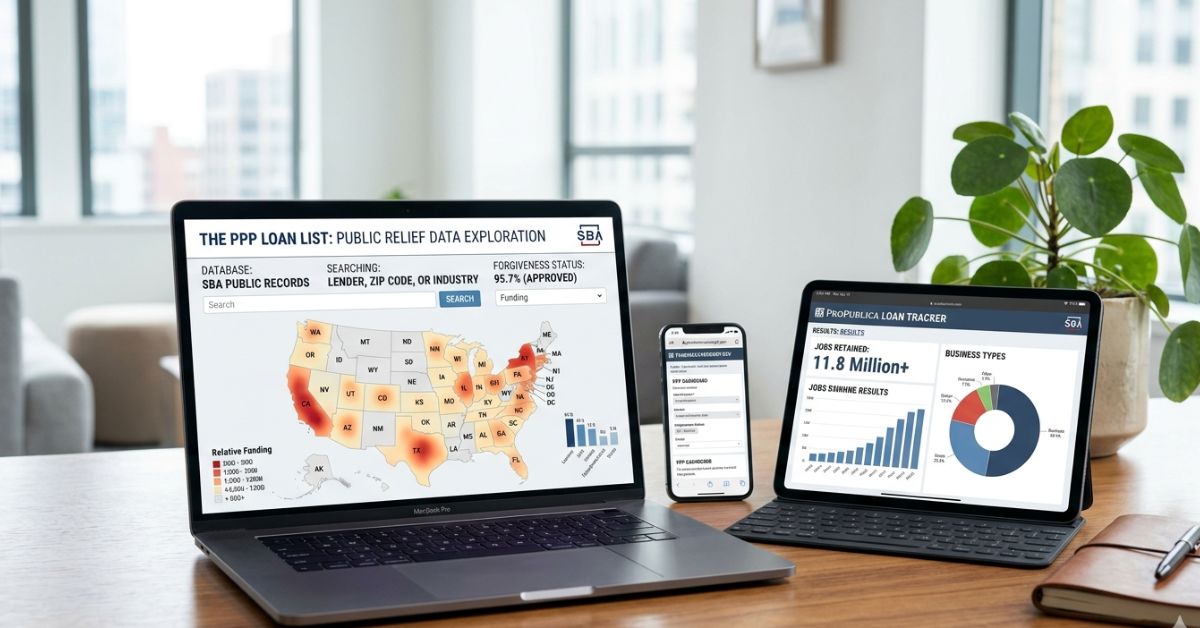
- ProPublica PPP Loan Tracker — the most user-friendly search interface, searchable by name, ZIP, lender, and industry
- PandemicOversight.gov — the federal oversight dashboard updated through December 2025, searchable and filterable
- FederalPay.org — powerful database allowing searches by company name, location, NAICS industry code, and loan amount
- HelloSkip.com — business-focused lookup tool with claim-your-listing functionality
Step 2: Enter Your Search Terms
Most search tools accept:
- Business or organization name (full or partial)
- Owner first/last name (for sole proprietors)
- ZIP code or city/state
- Lender name (e.g., JPMorgan Chase, Bank of America)
- Industry (NAICS code or keyword like “restaurant” or “dental”)
- Loan amount range
Step 3: Review the Results
Each record typically displays the business name, address, loan amount, lender, number of jobs reported retained, loan approval date, and forgiveness status. Results are drawn directly from the SBA’s public data release.
Step 4: Download the Full Data (Advanced Users)
For bulk research, the SBA offers downloadable CSV files organized by state and loan size range. These files contain every field in the public dataset and can be opened in Excel or Google Sheets or imported into data analysis software.
Best Databases and Tools to Look Up PPP Loans in 2025
Here is a comparison of the leading PPP loan search tools currently available:
1. ProPublica PPP Loan Tracker
URL: projects.propublica.org/coronavirus/bailouts/ Best for: Journalists, researchers, and general public Features: Search by business name, ZIP, lender, industry type; mobile-friendly; includes forgiveness data Data Source: SBA public data through June 1, 2021 Cost: Free
2. PandemicOversight.gov PPP Dashboard
URL: pandemicoversight.gov/ppp-simple-search-landing Best for: In-depth federal oversight research Features: Search borrowers and lenders; view how money was reported as used; forgiveness data updated as of December 2025 Cost: Free (government resource)
3. FederalPay PPP Database
URL: federalpay.org/paycheck-protection-program/ Best for: Business-level research with industry filters Features: Search by name, location, NAICS code, company type, loan amount; statistics by industry; largest loans listed Cost: Free
4. SBA.gov Official PPP Data
URL: sba.gov/funding-programs/loans/covid-19-relief-options/paycheck-protection-program/ppp-data Best for: Downloading raw bulk data for analysis Features: Full CSV downloads by state; demographic data; forgiveness metrics Cost: Free
5. HelloSkip PPP Search
URL: helloskip.com/ppp-data Best for: Business owners checking or claiming their own records. Features: Name or location search; business claim feature; links to EIDL data Cost: Free
What Information Is in the PPP Loan List?
Understanding exactly what the public record contains — and what it doesn’t — is important before you begin searching.
Fields That Are Publicly Available
| Field | Description |
|---|---|
| Business Name | Legal name of the borrowing entity |
| Business Address | Street address, city, state, ZIP |
| Loan Amount | Exact dollar amount (all loans, post-FOIA) |
| Lender Name | Bank or financial institution that issued the loan |
| Loan Approval Date | Date the SBA approved the loan |
| Industry (NAICS Code) | Business category classification |
| Business Type | LLC, sole proprietorship, corporation, nonprofit, etc. |
| Jobs Reported | Number of jobs the borrower reported retaining |
| Loan Status | Active, repaid, forgiven, or under review |
| Forgiveness Amount | Dollar amount officially forgiven |
| Forgiveness Date | When forgiveness was granted |
| Congressional District | Legislative district of the borrower |
What Is NOT in the Public Record
- Social Security Numbers
- Bank account numbers
- Internal financial documents submitted with the application
- Tax returns provided during underwriting
- Detailed personal financial data for sole proprietors
How to Search PPP Loans by State
One of the most common search queries is finding PPP loan recipients in a specific state. Every state’s loan data is available through both the SBA’s bulk download portal and through search tools like ProPublica and FederalPay.
Here are some key facts about how loans were distributed by region:
States with the Highest Total PPP Loan Dollars: California, Texas, New York, Florida, and Illinois collectively received a disproportionately large share of total funds, reflecting their large populations and business densities.
States with the Most Loans Issued: Small business density drove loan volume in states like Texas, California, and Florida, where independent businesses represent a significant portion of employment.
How to Filter by State: On ProPublica, enter a ZIP code or city name. On FederalPay, use the location filter. On SBA.gov, download the state-specific CSV file directly—files are labeled by state abbreviation for easy identification.
PPP Loan Forgiveness List: What Got Forgiven?
One of the most searched aspects of the PPP loan list is forgiveness status—specifically whether a loan was forgiven and for how much.
The Headline Numbers
The vast majority of PPP loans were ultimately forgiven. According to SBA and Pandemic Oversight data, more than 95% of total PPP loan dollars were either forgiven or approved for forgiveness. For loans under $150,000, a simplified forgiveness form (Form 3508S) made the process relatively quick for most borrowers.
What Qualified for Forgiveness
To have a PPP loan forgiven, borrowers were required to do the following:
- Use at least 60% of loan funds on payroll costs (salaries, wages, benefits)
- Use the remaining 40% only on eligible non-payroll expenses: rent, mortgage interest, utilities, and later-added categories, including software and supplier costs
- Maintain employee headcount and salary levels compared to the pre-pandemic baseline period
- Apply for forgiveness within the program’s designated window
Searching Forgiveness Status
The PandemicOversight.gov dashboard is the most current tool for checking forgiveness status. It shows whether a loan has been forgiven, partially forgiven, repaid, or remains in process. ProPublica and FederalPay also display forgiveness data, where available, in the SBA records.
What Happened to Unforgiven Loans
Loans that were not forgiven reverted to standard SBA loan terms: a 1% annual interest rate with a repayment term of either two or five years depending on when the loan was originated. Many unforgiven loans were either repaid voluntarily by large companies under public pressure or denied forgiveness due to eligibility issues.
Biggest PPP Loan Recipients — What the Data Shows
The PPP loan list reveals a wide range of loan sizes, from a few hundred dollars to the program maximum of $10 million per loan (with some larger organizations receiving multiple loans across affiliates).
Who Got the Largest Loans
According to FederalPay’s analysis of the SBA data, at least 4,840 companies across the United States received more than $5 million in PPP loans, with thousands more receiving the maximum $10 million.
Large recipients spanned virtually every industry:
- Healthcare and hospital networks received some of the largest amounts, justified by the payroll-based calculation formula
- Hotel chains and hospitality groups benefited from the elevated 3.5x payroll multiplier available in the second PPP round
- Law firms and professional service companies with large staff rosters qualified for significant loans
- Religious and nonprofit organizations received billions in aggregate across both draws
Banks as Lenders
The Government Accountability Office (GAO) found that banks made more than 93% of all loans in the first PPP round. Well-known institutions including JPMorgan Chase, Bank of America, Wells Fargo, and PNC were among the most active lenders. In later phases, fintech and non-bank lenders increased their share significantly as part of the SBA’s effort to reach underserved communities.
PPP Loan Fraud: What the List Exposed
The release of the PPP loan list opened the door to one of the largest fraud investigations in U.S. history.
Scale of the Problem
Estimates of fraudulent PPP loans range widely, but government investigators and independent analyses suggest tens of billions of dollars in potentially fraudulent loans were approved during the program’s rushed rollout. Common fraud schemes included:
- Ghost businesses — loans taken out for companies that did not exist or had no employees
- Identity theft — criminals using stolen personal information to apply for loans in others’ names
- Inflated payroll — real businesses submitting fabricated payroll records to obtain larger loan amounts
- Double-dipping — applying for loans through multiple lenders simultaneously
Prosecutions and Recoveries
The Department of Justice has charged hundreds of individuals with PPP fraud since the program’s launch. Charges have ranged from wire fraud and bank fraud to money laundering and identity theft. Many defendants have been convicted and sentenced to federal prison, with restitution orders in the millions. The extended statute of limitations means prosecutions will continue through the late 2020s.
How Journalists Used the List to Catch Fraud
Investigative journalists at outlets including ProPublica, the Miami Herald, and regional newspapers used the PPP loan database to cross-reference business registration records, tax filings, and employee counts—identifying loan recipients whose claimed payrolls did not match any verifiable business activity. This journalistic work contributed directly to law enforcement referrals.
PPP Loans and Politicians: What the Records Reveal
The PPP loan list became politically significant when researchers discovered that many elected officials, their families, and campaign donors appeared in the data.
Members of Congress
Multiple sitting members of Congress — including some who voted for the CARES Act — received PPP loans through businesses they or their family members owned. While receiving a PPP loan as a business owner is legal, the optics of voting for a relief bill and then personally benefiting from it drew scrutiny.
2024 Election Candidates
In a May 2024 investigation, MuckRock documented how PPP loan data was used to vet political candidates running for office. Candidates who promoted their business success during the pandemic while simultaneously collecting hundreds of thousands in PPP funds raised questions about accuracy and transparency in campaign messaging.
Lobbyists, Lawyers, and Well-Connected Firms
Law firms, lobbying organizations, and consulting companies with close ties to Washington also appeared prominently in the PPP data. While many of these loans were entirely legitimate—law firms, like any employer, had payroll costs—the disclosures led to broader conversations about who the program was truly designed to serve.
Is the PPP Loan List Still Public in 2025?
Yes. As of 2025, the PPP loan list remains fully public and accessible. Here is the current status of each major database:
- SBA.gov — Full CSV data downloads remain available. The program is closed, but the records are permanently maintained.
- PandemicOversight.gov — Launched a new interactive PPP dashboard in December 2025, replacing older visualizations that were retired in July 2025. Search and download functions remain active.
- ProPublica — The PPP Loan Tracker was last updated in October 2024 and remains searchable.
- FederalPay — Fully operational PPP database with search and filtering tools.
Federal records retention law requires the SBA to maintain these records for an extended period. The data is expected to remain accessible for many years.
What to Do If Your Business Is on the PPP Loan List
If your business received a PPP loan, your information is part of the public record. Here is what you should know:
Your record is permanent.
The SBA loan data is a matter of public record. It will not be removed from the database. If your loan information contains errors—a wrong address, a misspelled name, or an incorrect loan amount—the SBA is the only authority that can correct it. Contact the SBA directly, not any third-party database.
Forgiveness Status Matters
If you applied for and received forgiveness, that status should be reflected in the database. If it is not, contact your lender for a record of your forgiveness approval, then follow up with the SBA if necessary.
Tax Implications Are Settled
The IRS has confirmed that forgiven PPP loan amounts are not federally taxable income. However, state tax treatment varied; some states did treat forgiven amounts as income for state tax purposes. If you have questions about how your PPP loan was treated on prior-year returns, consult a qualified tax professional.
Ongoing Audit Risk
The SBA has the right to audit PPP loans at any time. Loans over $2 million were targeted for mandatory review. Even smaller loans may be audited if there are indicators of fraud or ineligibility. Businesses should retain all PPP-related documentation—payroll records, bank statements, and forgiveness applications—for at least six years.
Claiming Your Business Listing
On platforms like HelloSkip, business owners can claim their PPP listing to add context, update basic information, and control how the record appears in search results. This can be useful for businesses concerned about how the listing appears to customers, lenders, or partners.
Final Thoughts
The PPP loan list is one of the most consequential public records to emerge from the pandemic era. It is not just a historical document — it is an active resource used daily by journalists, researchers, auditors, business owners, and curious citizens.
For those looking up a specific business, verifying forgiveness status, or researching how pandemic relief was distributed in a specific community, the tools available in 2025 make the search easier than ever. The SBA’s data, combined with third-party platforms like ProPublica and FederalPay, puts the full picture at your fingertips.
What the PPP loan list ultimately shows is something bigger than dollars and loan numbers. It reflects a government program designed at extraordinary speed during an unprecedented crisis—with all the transparency, imperfection, and accountability that come with that territory. Understanding this data is understanding a chapter of American economic history that continues to shape policy, litigation, and public discourse today.
Frequently Asked Questions About the PPP Loan List
Q: Can I search the PPP loan list for free?
Yes. Every major PPP loan database — SBA.gov, ProPublica, PandemicOversight.gov, FederalPay, and HelloSkip — is free to search with no registration required.
Q: How do I look up a specific business on the PPP loan list?
Go to ProPublica’s PPP Loan Tracker or FederalPay.org, enter the business name in the search bar, and filter by state if needed to narrow results. Both tools search the full SBA public dataset.
Q: Are individual names on the PPP loan list?
For sole proprietors and self-employed individuals who received loans, names may appear in the dataset as the business name, particularly for loans over $150,000. However, Social Security Numbers and personal financial details are not included.
Q: Was my PPP loan forgiven automatically?
No. Forgiveness required a separate application submitted to your lender. Loans under $150,000 could use the simplified Form 3508S. If you never applied for forgiveness, your loan was not automatically forgiven.
Q: Can I get a PPP loan today in 2025?
No. The PPP application window closed on May 31, 2021. The program is no longer accepting applications. If you need small business funding today, explore current SBA loan programs, including 7(a) loans, 504 loans, or SBA microloans.
Q: What if my business appears on the PPP loan list incorrectly?
Contact the SBA directly to request a correction to your loan record. Third-party databases pull directly from SBA data and cannot make changes on your behalf.
Q: Does appearing on the PPP loan list affect my credit score?
No. PPP loans were not reported to commercial credit bureaus. Receiving or repaying a PPP loan has no direct impact on your business or personal credit score.
Q: How long will the PPP loan list remain public?
Indefinitely. Federal records retention requirements ensure this data will remain part of the public record for the foreseeable future. The data is expected to be accessible online for many years.
This article is for informational purposes only. It does not constitute legal, financial, or tax advice. For questions about your specific PPP loan, forgiveness application, or potential audit exposure, consult a qualified attorney or CPA familiar with SBA programs.