

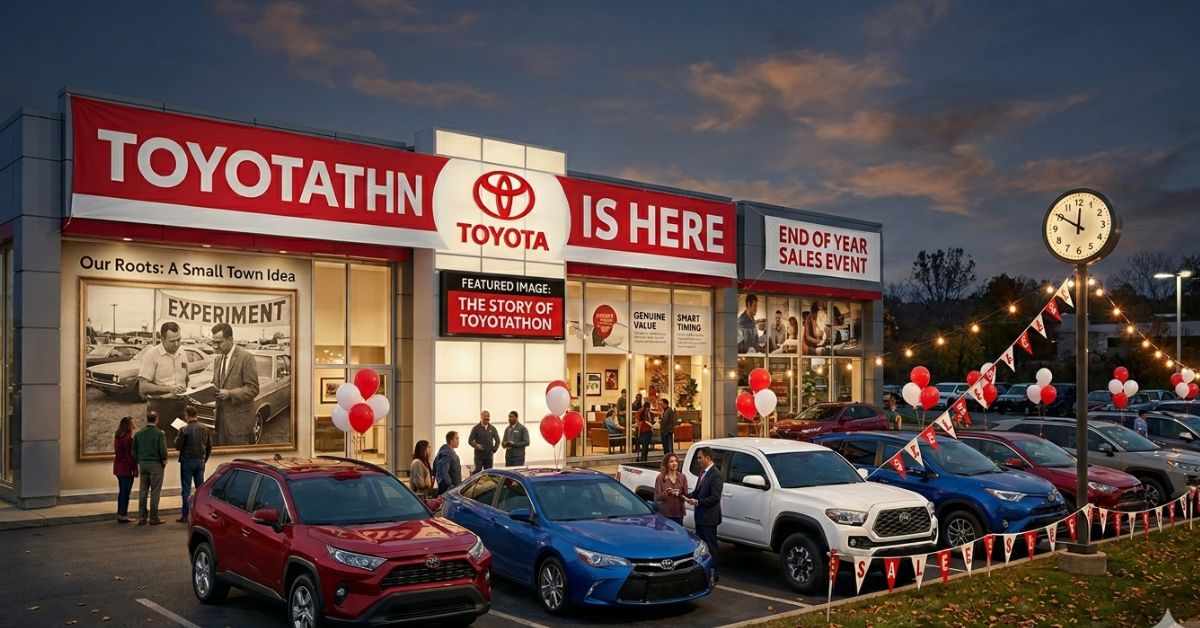
Walk into almost any room in America during the holiday season and mention Toyotathon — chances are, at least one person will know exactly what you’re talking about. Maybe they’ve seen the commercials dozens of times. Maybe they actually bought their car during one. Either way, the name alone carries a kind of weight that most promotional events never manage to earn. But what is Toyotathon, really? Where did it come from, and is it actually worth paying attention to if you’re in the market for a new car? The answers are worth knowing.
The Surprising Story of How It All Started
Toyotathon didn’t come from a polished marketing agency or a Toyota executive’s boardroom. It started in a small dealership in Clinton, North Carolina, in the late 1970s, where a marketing manager and a local advertising rep were staring at sluggish sales numbers and trying to figure out what to do about them. Their idea was simple but bold — run one massive, concentrated promotional push instead of spreading efforts thin across the whole year. They gave it a name that felt big enough to match the ambition: Toyotathon. The goal was 500 vehicles sold over a matter of weeks. They fell just short, moving around 450, but the results were impossible to ignore.
Jim Moran, who headed Southeast Toyota Distributors and had a sharp eye for what worked, caught wind of the experiment. He scaled the idea up and ran a holiday version of it nationally in late 1979. From that point forward, Toyotathon was no longer a local gamble — it was a strategy.
Some accounts also reference an even earlier version of the event, reportedly a 36-hour, nonstop sales blitz where dealerships stayed open around the clock and television ads ran in heavy rotation. That campaign is said to have cost roughly $250,000 and returned close to $13 million in vehicle sales — more than 3,000 units in a day and a half. Whether it predated or ran alongside the North Carolina story, the takeaway was the same: concentrated effort, concentrated results.
What Toyotathon Actually Looks Like Today
Fast forward to the present and the structure of Toyotathon is still built on that same core idea — a defined window of time, loaded with incentives, designed to give buyers a real reason to act. The event typically runs from mid-to-late November through the first week of January, spanning roughly six to eight weeks. The 2025 edition opened on November 19 and closed on January 5, 2026.
During that window, Toyota pushes its most significant national incentives to the forefront. Buyers can usually find cash rebates that knock money off the purchase price immediately, special financing rates that often sit well below the standard market rate for well-qualified buyers, and lease deals that come with lower monthly payments and reduced upfront costs. On top of what Toyota offers nationally, individual dealerships frequently run their own promotions, which can mean additional discounts on specific models or trims they’re particularly eager to move before the year ends.
The vehicles covered span a wide range. Shoppers looking at sedans will find deals on the Camry and Corolla. Families drawn to SUVs can explore offers on the RAV4, Highlander, and Grand Highlander. Truck buyers have the Tacoma and Tundra. And as hybrid vehicles have grown in popularity, Toyota’s electrified lineup — including the RAV4 Hybrid, Camry Hybrid, and Corolla Hybrid — has become an increasingly prominent part of the event each year.
Why the Timing Makes Sense for Everyone
The holiday window isn’t just sentimental — it’s strategic, and it works in buyers’ favor in ways that aren’t always obvious. By November, dealerships are carrying current-model-year inventory that needs to move. New model-year vehicles start arriving early in the year, which means dealers have a real financial incentive to clear space on the lot. That urgency tends to make them more flexible, and when you layer Toyota’s national incentives on top of a motivated dealership, the result is often the most competitive pricing of the entire calendar year.
For Toyota as a company, concentrating incentive spending into one event is simply more effective than spreading it across twelve months. The limited timeframe creates urgency for buyers, the advertising spend builds momentum, and the scale of participation across thousands of dealerships gives the event a gravitational pull that individual promotions can’t match.
More Than Just a Sale — A Piece of American Pop Culture
Not many car sales events end up as internet memes, but Toyotathon managed it. Part of that is longevity — the event has been running in recognizable form for nearly five decades, which means entire generations grew up seeing those commercials. But a bigger part is the way Toyota chose to advertise it.
While other automakers filled their holiday spots with interest rate comparisons and countdown clocks, Toyota’s Toyotathon ads told quiet human stories. Parents and kids, long drives, old trucks still going strong. The “Oh What a Feeling!” slogan introduced in 1979 wasn’t selling horsepower or cargo space — it was selling a feeling, which turned out to be a much harder thing to forget.
By the 2010s, social media had turned Toyotathon into something of a seasonal joke — people wishing each other a happy Toyotathon, debating its place in the holiday hierarchy, treating it like a legitimate cultural event. The Onion parodied it. The Daily Show referenced it. That kind of organic cultural presence is something money can’t easily manufacture, and Toyota has it.
How to Actually Get the Best Deal
Knowing Toyotathon exists is one thing. Walking out of a dealership with the best possible deal is another. The manufacturer’s advertised incentives — the APR rates, lease terms, and cash rebates — are fixed at the national level and not subject to negotiation. But the selling price of the vehicle, your trade-in value, and any dealer fees very much are. Some of the strongest savings during Toyotathon come from dealer-level promotions that don’t always make it into the headline advertising. Doing the research before you walk in — knowing the invoice price, getting an independent trade-in appraisal, comparing offers at more than one dealership — puts you in a far stronger position than relying on the advertised figure alone.
The Bottom Line
Toyotathon has earned its place in the American calendar through a combination of smart timing, consistent advertising, and genuine value for buyers. It started as an experiment by two people at a small-town dealership trying to think their way out of a problem, and it grew into something that millions of people recognize by name every single year. For anyone thinking about buying a Toyota, it remains one of the most practical windows of the year to do it — provided you know what to look for when you get there.